Let’s be honest about London: it’s one of the most expensive cities on earth. Pints north of £7, hotel rooms that feel like cupboards for the price of a decent Airbnb elsewhere, and attraction entry fees that can genuinely shock visitors who haven’t looked at London trip cost 2026 figures before arriving. But here’s what the ‘London is expensive’ conversation usually misses: London is also a city where some of the world’s greatest museums are entirely free, street food is extraordinary and budget-friendly, parks are vast and always open, and one smart purchasing decision, say London Tourist Pass, can cut your single biggest controllable cost by up to 50%.
This is the honest, line-by-line breakdown. We’re going through every category: flights, accommodation, transport, food, London attractions, and connectivity — with real 2026 figures, not rounded guesses. We’ll show you where London trip cost 2026 can be controlled and where it can’t, and how to spend less without spending a worse time.
Short answer: A mid-range 3-night London trip costs approximately £600–1,200 per person (excluding flights). The single biggest controllable cost is paid London attraction entry. The London Tourist Pass saves up to 50% on tickets — the most impactful budget lever available to any visitor.
Abbreviations to NOTE
-
London Tourist Pass (LTP)
-
Build Your Own Pass (BYOP)
The Full London Trip Cost Breakdown (2026)
Here’s every major cost category for a typical 3-night, 4-day London trip, across three spending levels:
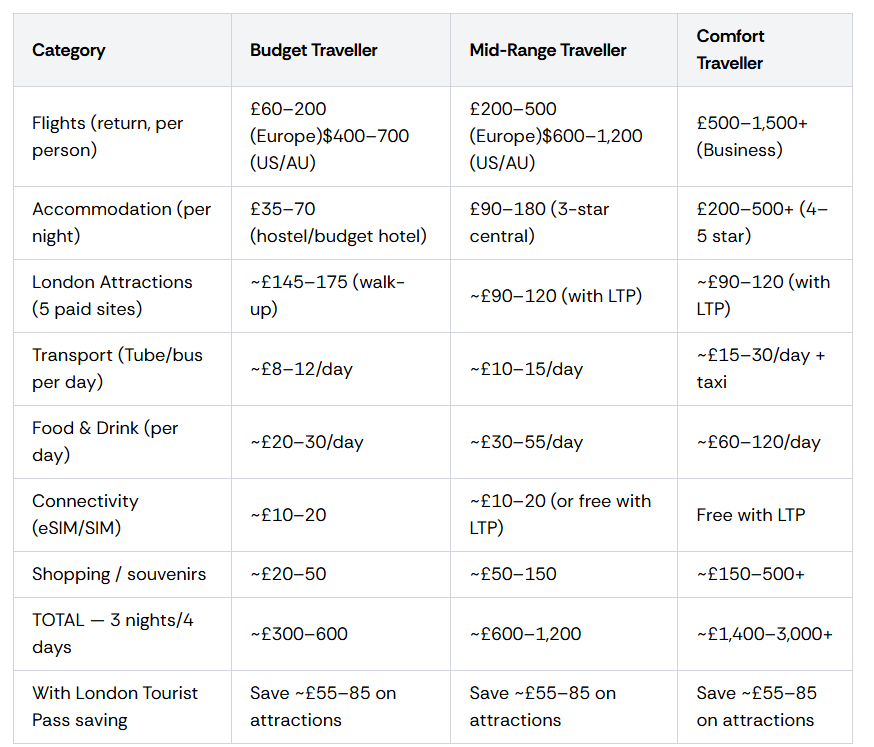
All figures are approximate per-person estimates for 2025–2026. Flights are the most variable category and depend heavily on your origin, booking lead time, and flexibility. Attraction costs with the London Tourist Pass assume a five-attraction BYOP selection — savings of approximately 40% versus walk-up prices.
Flights to London: What to Budget in 2026
London is one of the best-connected cities in the world. Heathrow (LHR) handles the most international passenger traffic of any European airport; Gatwick (LGW), Stansted (STN), Luton (LTN), and London City (LCY) add enormous additional capacity across budget and full-service carriers.
From North America
Direct return flights from New York (JFK, EWR, or Newark) to London Heathrow start from approximately $500–700 in economy with carriers including British Airways, Virgin Atlantic, American Airlines, and Delta. Peak summer (July–August) and Christmas/New Year push prices to $900–1,500+. Book 8–12 weeks ahead for the best economy fares. From the US West Coast (LA, San Francisco), budget $600–900 for direct return flights; Chicago and Toronto add one to two more hours of flying time at comparable prices.
From Europe (Including Long-Stay Backpackers)
Budget carriers make London extraordinarily accessible for European visitors. easyJet, Ryanair, and Wizz Air connect dozens of European cities to Stansted, Luton, and Gatwick from £20–60 each way during shoulder season. For backpackers planning a longer European trip with London as a stop, the Eurostar from Paris (from £39 one way, 2h20) and Brussels is worth considering as an alternative to flying — no airport security theatre, no baggage fees, and you arrive at St Pancras International in the heart of Zone 1. Note: the UK is not in the Schengen zone, so you’ll go through passport control, but EU/EEA passport holders typically clear quickly.
From Australia, Asia & the Middle East
Direct flights from Sydney to London run approximately 22 hours with carriers including Qantas and British Airways, from AUD $1,200–2,500 return in economy. From Singapore, direct flights via Singapore Airlines, British Airways, or Virgin Atlantic take approximately 13 hours from SGD $700–1,400. From Dubai (Emirates’ home hub), the direct flight to Heathrow takes 7 hours and fares start around AED 2,000–4,000 return. These are among the world’s most-flown routes — competition keeps prices relatively reasonable outside peak periods.
Accommodation in London: What to Expect in 2026
London accommodation is one of the least forgiving line items in any London trip cost 2026 budget. Here’s what the market actually looks like:
Budget hostels in Zone 1–2 (Shoreditch, Kings Cross, Paddington): £35–70 per person per night in a dormitory. Private rooms in decent budget hotels in Zone 2–3: £70–120 per night. Mid-range three-star hotels in Central London: £90–180 per night. Four-star hotels in Mayfair, Covent Garden, or Chelsea: £200–400+ per night. Five-star properties (Claridge’s, The Ritz, The Savoy): £500–1,500+ per night. For most mid-range visitors, a hotel in Zone 2 (Bethnal Green, Stratford, Balham, Clapham) delivers a dramatic price reduction — often 40–60% less than Zone 1 equivalents — with excellent Tube access into the centre.
Book at least six weeks ahead for summer. For families, one-bedroom serviced apartments can be cheaper than two hotel rooms and include kitchen facilities that cut food costs meaningfully.
The London Tourist Pass: How Much Can You Actually Save?
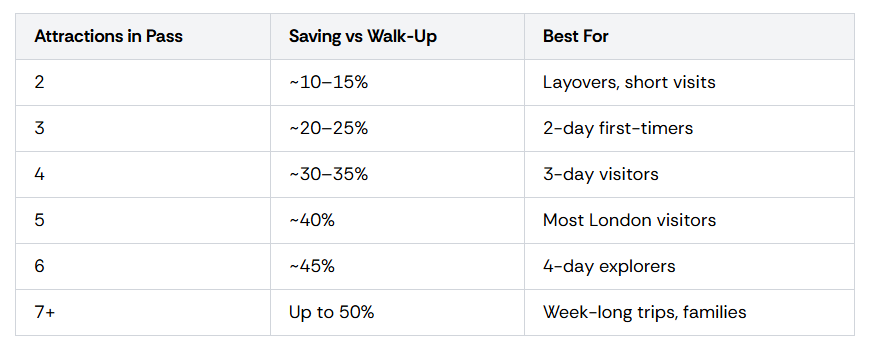
The London Tourist Pass uses a progressive savings model — the structural advantage that separates it from every other attraction pass in London. Unlike flat-rate or tier-based passes where you pay for a bracket and hope you fill it, the LTP’s Build Your Own Pass adjusts your savings in real time as you add attractions. There are no tiers, no upfront guessing, and no mid-trip regret.
Transport Costs in London: Oyster, Contactless & Getting Around
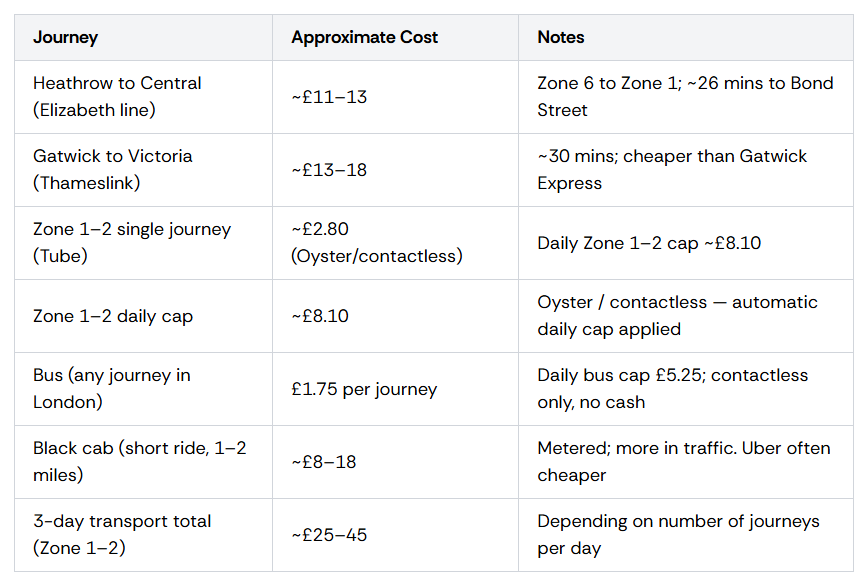
The London Tourist Pass covers attraction entry only. Transport is a separate cost — but London’s public transport network is excellent and, with the right setup, not expensive.
The free eSIM included with every London Tourist Pass means you’ll have mobile data from arrival — essential for using Google Maps, Citymapper, and Uber without running up roaming charges. For international visitors, this alone is worth £10–25 they’d otherwise spend at the airport or online before arriving.
Food & Drink in London: Real Costs for 2026
London’s food scene is one of its great surprises for first-time visitors: the city that was once mocked for its cuisine now has more Michelin-starred restaurants than Paris, extraordinary street food from every part of the world, and a pub culture that remains one of the planet’s finest institutions. Here’s what things genuinely cost:
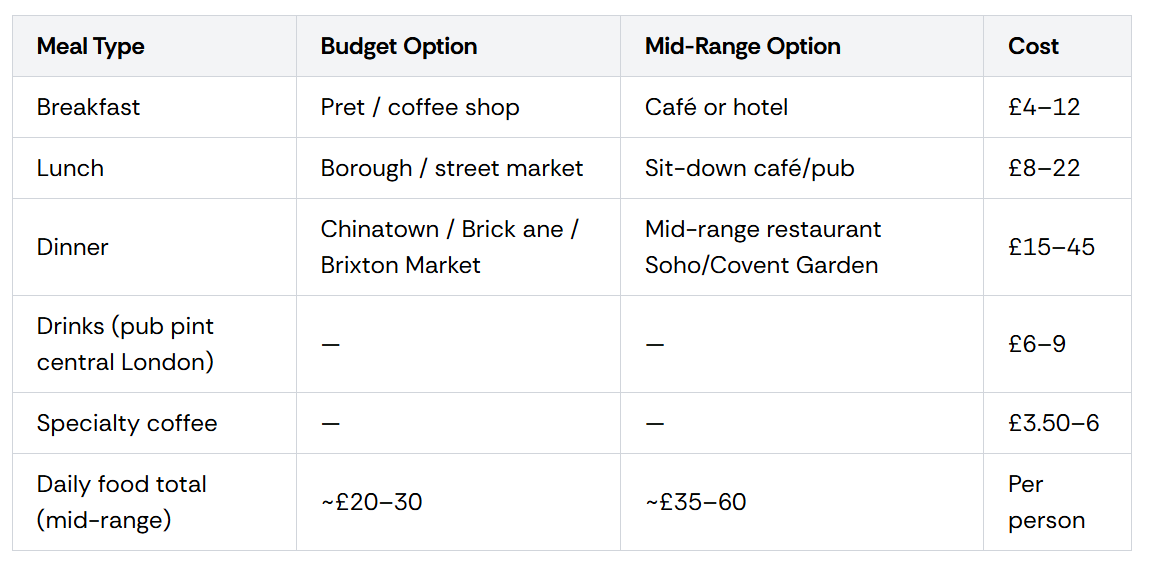
Budget travellers who use London’s markets — Borough Market, Maltby Street Market, Brixton Market, Spitalfields, and the various street food setups in Southwark and Whitechapel — eat extraordinarily well for £10–20 per meal. Avoiding the sit-down tourist restaurants near the Tower of London, Covent Garden (beautiful, overpriced for food), and Leicester Square is the single most impactful food budget decision you can make.
London’s pub culture deserves special mention. A good pub lunch — a proper pie, a roast, or fish and chips — in a neighbourhood pub away from the tourist zone costs £12–18. Pints of ale in the same pub: £5.50–7.50. This is cheaper and more authentically London than almost any restaurant alternative.

